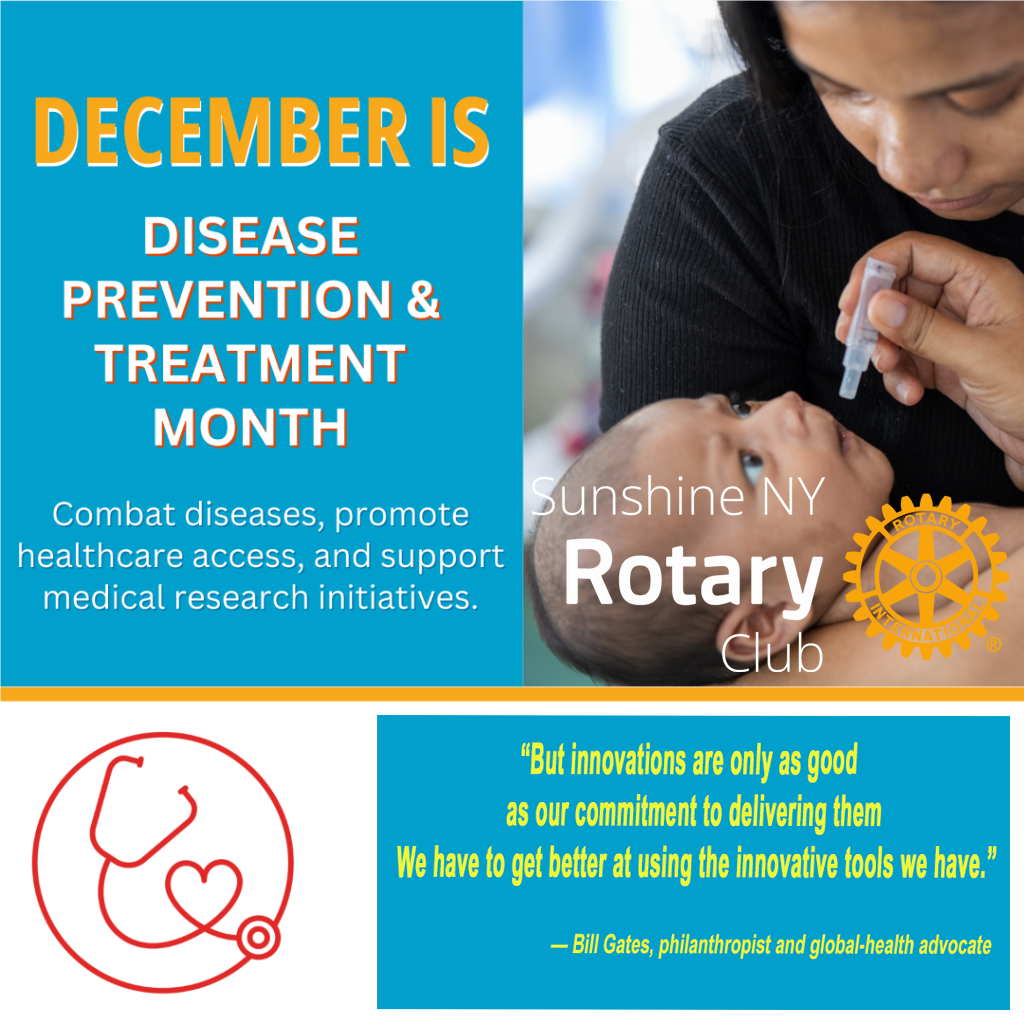
December is Disease Prevention & Treatment Month
- July - Maternal & Child Health Month
- August - Membership & New Club Development Month
- September - Basic Education & Literacy Month
- October - Economic & Community Development Month
- November - Rotary Foundation Month
- December - Disease Prevention & Treatment Month
- January - Vocational Service Month
- February - Peace and Conflict Prevention Month
- March - Water, Sanitation & Hygiene Month
- April - Environment Month
- May - Youth Service Month
- ALL ROTARY MONTHLY THEMES
Prevention Protects Lives—Treatment Restores Hope
Each December, Rotary recognizes Disease Prevention and Treatment Month, a time for Rotary and Rotaract clubs to help communities prevent illness, expand access to appropriate treatment, strengthen health systems, and promote healthier lives.
 Good health affects every part of human development. When people are protected from preventable disease and can obtain timely, affordable care, children are more likely to attend school, adults can remain productive, families are less likely to fall into poverty, and communities become stronger and more resilient.
Rotary believes that access to health care is a fundamental human need. Yet Rotary International reports that 4.6 billion people lack access to essential health services. Rotary members respond by working with health professionals, governments, community organizations, and residents to address preventable and treatable causes of illness while promoting equitable access to care.
“But innovations are only as good as our commitment to delivering them. We have to get better at using the innovative tools we have.”
— Bill Gates, philanthropist and global-health advocate
Prevention and Treatment Belong Together
Disease prevention includes more than vaccination. It also involves health education, clean water and sanitation, good nutrition, routine screening, safe environments, healthy behavior, early diagnosis, and systems that can identify and contain health threats.
Treatment is equally important. A screening program has limited value when people who receive an abnormal result cannot obtain follow-up care. A medicine donation will not create lasting change if health workers are not trained to prescribe it appropriately, supply chains cannot replenish it, or patients cannot afford transportation to the clinic.
Effective health projects connect the full continuum of care:
- Prevention and public education
- Screening and early detection
- Diagnosis
- Referral
- Appropriate treatment
- Rehabilitation and continuing care
- Patient follow-up
- Monitoring and evaluation
The strongest projects do not choose between prevention and treatment. They build systems capable of providing both.
Rotary’s Leadership in Global Health
Rotary’s best-known health initiative is the campaign to eradicate polio. Since Rotary launched its polio program in 1985, global polio cases have been reduced by 99.9 percent. The infrastructure developed through this effort—including trained health workers, laboratories, surveillance networks, vaccination systems, and community relationships—has also helped health authorities respond to other diseases and public-health emergencies.
Rotary’s work extends far beyond polio. Members support projects involving:
- Malaria prevention, diagnosis, and treatment
- HIV prevention, testing, and care
- Tuberculosis detection and treatment
- Cervical-cancer vaccination, screening, and treatment
- Diabetes education and management
- Heart disease and hypertension
- Mental health and addiction
- Alzheimer’s disease and dementia
- Vision, hearing, and dental health
- Blood donation and safe blood supplies
- Community health-worker training
- Telemedicine and mobile health services
Since 2014, Rotary has awarded approximately US$454 million in grants to fight disease. Rotary is also building on its polio experience to expand cervical-cancer prevention and strengthen community health systems through trained health workers.
Begin with the Community
Every community has different health needs. A project that is effective in one location may be inappropriate in another.
Before organizing a clinic, purchasing equipment, importing supplies, or developing a grant application, clubs should conduct a community assessment and consult:
- Patients and caregivers
- Community health workers
- Physicians, nurses, pharmacists, and other health professionals
- Hospitals and community health centers
- Public-health departments
- Schools and senior centers
- Organizations serving immigrants, refugees, veterans, or people with disabilities
- Local government and health authorities
- Community and faith-based organizations
We need to ask:
- Which diseases create the greatest burden in the community?
- Which populations are least able to obtain care?
- What prevents people from seeking treatment?
- Are language, transportation, cost, disability, fear, or distrust significant barriers?
- Which preventive services are underused?
- What services already exist?
- Where are the gaps in screening, diagnosis, referral, and treatment?
- What would the community consider a successful outcome?
- How will the work continue after Rotary’s direct involvement ends?
Rotary’s service guidance recommends using reliable health data, working within established health systems, consulting community leaders and medical professionals, avoiding duplication, and building projects around demonstrated local priorities.
What Can Our Club Do Locally?
A club does not need to operate a medical mission or finance a major facility to improve health. Local projects can be practical, affordable, and highly effective when undertaken with qualified partners.
As a club, we could:
- Organize a blood drive with an accredited blood-service organization.
- Support a community health fair offering evidence-based screening and referrals.
- Partner with health authorities to promote recommended vaccinations.
- Sponsor blood-pressure, diabetes, vision, hearing, or dental screening.
- Provide transportation assistance for medical appointments and treatment.
- Support a mobile clinic serving isolated or underserved communities.
- Organize health-literacy workshops led by qualified professionals.
- Help residents understand how to use local health services.
- Provide multilingual health information developed or approved by medical authorities.
- Support mental-health education, peer-support, or suicide-prevention programs through qualified organizations.
- Partner with addiction-treatment and recovery organizations.
- Support families caring for people with Alzheimer’s disease or dementia.
- Assist a hospital, hospice, community clinic, or family health center with needs it has identified.
- Recruit health professionals to provide training or technical assistance.
- Support approved programs promoting nutrition, physical activity, smoking cessation, and chronic-disease management.
- Help eligible residents enroll in available health and insurance programs.
- Assemble patient-comfort or caregiver-support packages requested by a health partner.
- Promote organ, tissue, bone-marrow, or blood donation through the appropriate accredited organizations.
Districts have also encouraged clubs to organize health workshops, free checkups, vaccination campaigns, mental-health programs, and partnerships with hospitals and clinics—but always with qualified providers and suitable follow-up services.
Opportunities for International Service
International health projects require careful planning, strong host-community leadership, and coordination with the country’s health authorities.
Clubs can:
- Train and equip community health workers.
- Strengthen malaria-prevention and treatment programs.
- Support tuberculosis testing, referral, and treatment adherence.
- Expand HIV testing and access to care.
- Support HPV vaccination and cervical-cancer screening.
- Improve maternal, newborn, and pediatric health services.
- Strengthen laboratory and diagnostic capacity.
- Develop telemedicine services for remote communities.
- Support mobile clinics where they are integrated with existing health systems.
- Improve clean water, sanitation, hygiene, and infection control in health facilities.
- Train health professionals through scholarships, continuing education, or vocational training teams.
- Improve medical referral and emergency-transportation systems.
- Support rehabilitation, prosthetic, vision, hearing, or dental services.
- Develop district or global grants addressing a documented health priority.
Rotary’s Programs of Scale and other health initiatives demonstrate the value of training local health workers, strengthening community-based systems, and integrating prevention, diagnosis, treatment, and referral rather than relying exclusively on occasional outside medical missions.
Support Community Health Workers
Community health workers frequently serve as the first connection between families and the formal health system. Because they live in or near the communities they serve, they can communicate in familiar languages, recognize cultural concerns, provide basic education, identify warning signs, conduct approved testing, and refer patients for further care.
Rotary-supported programs have trained and equipped community health workers to address malaria, pneumonia, diarrheal disease, maternal and child health, and other community priorities. Their effectiveness depends on continuing supervision, reliable supplies, appropriate compensation, clear referral procedures, and connections to functioning clinics.
Investing in people often produces a more sustainable result than purchasing equipment alone.
Use Medical Donations Responsibly
Donating medical equipment or supplies can be helpful, but an unsuitable donation may create expense, waste, or risk for the recipient.
Before donating, we should confirm:
- The equipment was specifically requested.
- It meets local clinical and regulatory requirements.
- Qualified personnel are available to operate it.
- Training will be provided.
- Electricity, water, internet, or other infrastructure is dependable.
- Replacement parts and consumable supplies are locally available.
- Maintenance and repair can be performed.
- Instructions are available in an appropriate language.
- Medicines and supplies will not expire before use.
- Storage and transportation requirements can be maintained.
- The recipient accepts responsibility for long-term operation.
- The donation will not displace a more suitable locally available product.
A donated machine that cannot be repaired is not a sustainable health project. A successful donation includes training, maintenance, budgeting, supply-chain planning, and continuing evaluation.
Make Prevention a Priority
Preventing illness is generally less disruptive and less costly than treating advanced disease. Prevention also gives clubs opportunities to involve members who are not health professionals.
Rotary clubs can promote prevention by supporting:
- Evidence-based health education
- Immunization
- Clean water and sanitation
- Handwashing and infection control
- Good nutrition
- Regular physical activity
- Tobacco cessation
- Responsible medication use
- Routine medical, dental, vision, and hearing care
- Screening based on professional guidelines
- Mosquito-net use and vector control
- Safe pregnancy and newborn care
- Mental-health awareness
- Reduction of stigma surrounding illness and treatment
Health messages should come from reputable medical and public-health authorities. It is important to remember that Rotary members should not diagnose conditions, recommend individual treatments, or make unsupported medical claims unless they are qualified and authorized to do so.
Include Mental Health
Health includes mental and emotional well-being.
Depression, anxiety, trauma, dementia, addiction, loneliness, and other conditions affect individuals, families, workplaces, and communities. Stigma can prevent people from seeking help, while shortages of providers and inadequate insurance coverage may make treatment difficult to obtain.
Clubs can contribute by:
- Hosting educational programs led by licensed professionals
- Promoting reputable crisis and referral resources
- Supporting caregiver respite and peer-support programs
- Partnering with qualified mental-health and addiction organizations
- Training members to recognize warning signs and respond appropriately
- Supporting veterans, young people, older adults, refugees, and others facing particular risks
- Promoting respectful, non-stigmatizing language
Several Rotary districts and Rotary Action Groups now explicitly include mental health, addiction prevention, dementia, and caregiver support within their disease-prevention activities.
Connect Rotary’s Areas of Focus
Disease does not exist in isolation. Health outcomes are influenced by education, income, nutrition, housing, water, sanitation, environmental conditions, conflict, and access to transportation.
Disease Prevention and Treatment connects naturally with Rotary’s other areas of focus:
Maternal and child health: Prenatal care, immunization, nutrition, skilled childbirth care, and early treatment protect mothers and children.
Water, sanitation, and hygiene: Safe water, toilets, handwashing, waste disposal, and infection control reduce the spread of disease.
Basic education and literacy: People need understandable information to recognize symptoms, follow treatment, use medicines safely, and make informed health decisions.
Community economic development: Illness can prevent people from working and push families into poverty, while poverty itself creates barriers to care.
Peacebuilding: Conflict damages health facilities, interrupts medication supplies, displaces health workers, and increases the spread of disease.
The environment: Air pollution, unsafe water, changing climates, and degraded ecosystems can increase health risks.
Integrated projects can often achieve better and more durable results than narrowly defined interventions.
Build Partnerships
Rotary’s role is often to convene the right people.
Potential partners include:
- Hospitals and community health centers
- Public-health agencies
- Universities and medical schools
- Nursing, pharmacy, dental, and public-health programs
- Professional medical associations
- Schools and libraries
- Senior and community centers
- Organizations serving vulnerable populations
- Government health authorities
- Rotary Action Groups
- Rotary and Rotaract clubs in project communities
- The Rotary Foundation’s Cadre of Technical Advisers
Rotary Action Groups can help clubs locate technical expertise, evaluate proposed interventions, develop partnerships, and avoid common project-planning errors. Rotary specifically recommends consulting relevant Action Groups and collaborating with established health organizations.
Sunshine Rotary in Action
Sunshine Rotary has supported disease prevention through public awareness, fundraising, blood donation, health education, and participation in Rotary’s continuing campaign to end polio.
Walking to End Alzheimer’s
Sunshine Rotary joined other newer District 7230 clubs in supporting the Walk to End Alzheimer’s. Members participated with club banners, helped raise awareness, and contributed to district fundraising for research, care, and support for people living with Alzheimer’s disease and other forms of dementia.
Participation in a public walk may appear simple, but it can help reduce stigma, connect families with resources, support research, and remind caregivers that they are not alone.
Continuing the Fight Against Polio
The Club has participated in World Polio Day fundraising and educational activities and has shared information about the continuing risks of poliovirus, including its detection in New York wastewater and the confirmed Rockland County case.
Sunshine leaders also attended a District 7230 program featuring Mike McGovern, chair of Rotary’s International PolioPlus Committee, where participants learned why vaccination, surveillance, community trust, and continuing financial support remain essential until transmission is stopped everywhere.
Giving Blood and Promoting Emergency Preparedness
Sunshine Director Ashfaque Salim donated blood three times through blood drives organized by the Smart Rotaract Club. His Paul Harris Fellow recognition was presented during a Blood Drive and CPR Training program hosted by the Rotary E-Club of Heritage, New York.
These activities demonstrate that clubs can contribute to disease prevention and treatment in many ways: supporting immunization, promoting early detection, donating blood, teaching lifesaving skills, reducing stigma, fundraising for research, and connecting people with reliable health information.
Measure Lasting Change
Counting patients, tests, supplies, or clinic visits describes activity. Measuring whether health improved demonstrates impact.
Depending on the project, clubs might measure:
- People completing recommended vaccinations
- Participants receiving follow-up after an abnormal screening
- Patients beginning and completing treatment
- Improved disease knowledge or preventive behavior
- Community health workers trained and retained
- Increased use of local health services
- Reduced delays in diagnosis or referral
- Improved treatment adherence
- Facilities maintaining reliable supplies and functioning equipment
- Reduced incidence or complications of a targeted disease
- Improved patient satisfaction and trust
- Services continuing after Rotary funding ends
Collect baseline information before the project begins. Establish realistic indicators with health professionals and community partners. Protect patient privacy and comply with applicable health-information laws.
A sustainable project should produce measurable benefits without creating permanent dependence on Rotary funding.
Take Action This December
Disease prevention and treatment are not only medical concerns. They are matters of opportunity, equity, dignity, and human development.
This December, let us listen to our communities, work with qualified professionals, support trusted health institutions, promote accurate information, and invest in systems that continue protecting people long after a single event or grant has ended.
Whether your club organizes a blood drive, supports a vaccination campaign, trains community health workers, promotes mental-health services, provides transportation to care, or develops a larger Foundation-funded initiative, every thoughtful action can help prevent suffering and save lives.
What will your club do to build a healthier community?
Share your club’s projects, partnerships, results, and photographs with our District's Public Image team. By telling these stories, we can recognize our members as People of Action, inspire other clubs, attract new partners, and demonstrate how Rotary service creates lasting impact.
Rotary Resources
- Rotary International — Fighting Disease
- Disease Prevention and Treatment Guidelines for Global Grant Funding
- Rotary Service Project Center
- Rotary Community Assessment Tools
- The Rotary Foundation — Global Grants
- Rotary Action Groups addressing health and disease
- End Polio Now
- Rotary Family Health Days
- Rotary Brand Center health photographs and communications resources