
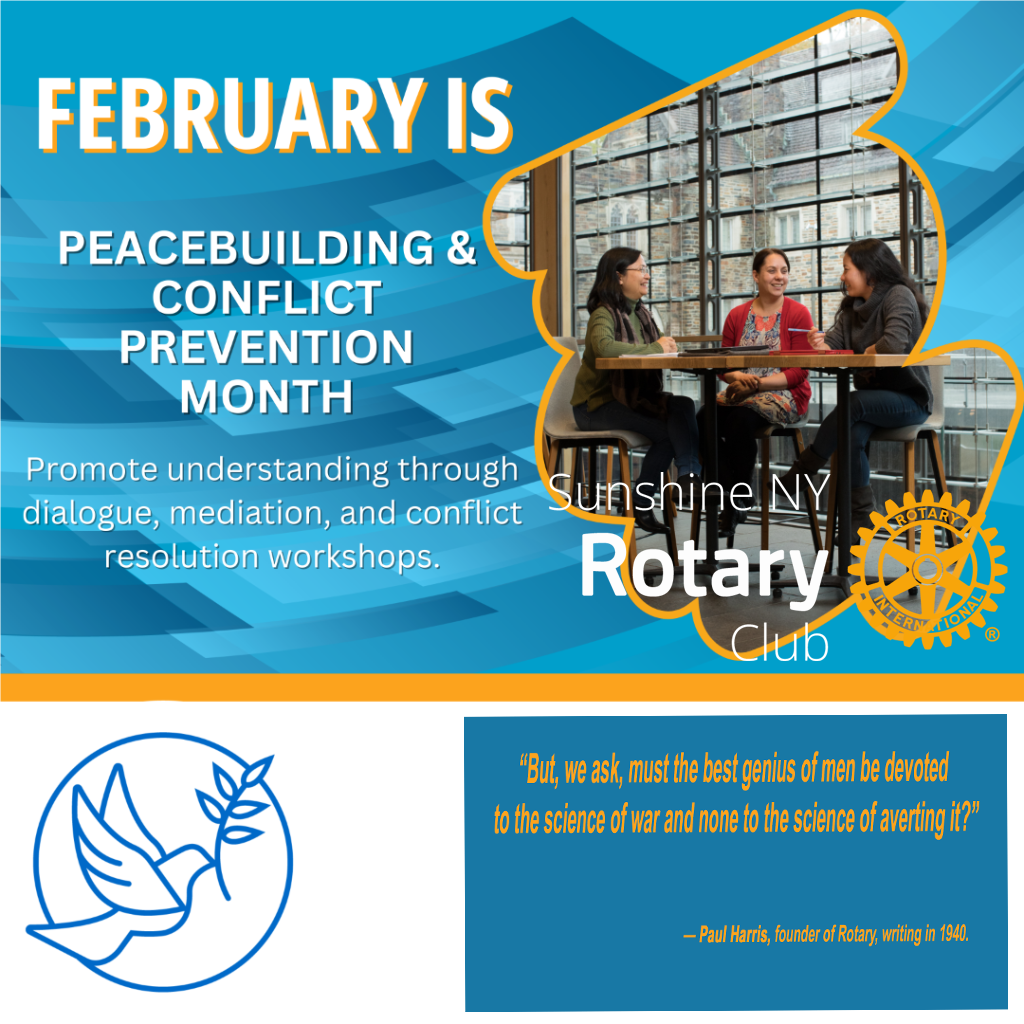
February is Peacebuilding and Conflict Prevention Month
- July - Maternal & Child Health Month
- August - Membership & New Club Development Month
- September - Basic Education & Literacy Month
- October - Economic & Community Development Month
- November - Rotary Foundation Month
- December - Disease Prevention & Treatment Month
- January - Vocational Service Month
- February - Peace and Conflict Prevention Month
- March - Water, Sanitation & Hygiene Month
- April - Environment Month
- May - Youth Service Month
- ALL ROTARY MONTHLY THEMES
Peace Begins with Understanding
—and Grows Through Action
Each February, Rotary recognizes Peacebuilding and Conflict Prevention Month, a time for Rotary and Rotaract members to strengthen understanding, address the causes of conflict, support people affected by violence and displacement, and help create communities in which peace can endure.
Peacebuilding is not limited to negotiating an end to war. It takes place wherever people listen respectfully, overcome prejudice, resolve disagreements without violence, protect human dignity, expand opportunity, and work together across political, cultural, religious, racial, and economic differences.
Rotary invests in peace education, develops skilled peacebuilders, strengthens partnerships, and integrates peacebuilding into humanitarian service. Rotary members also address conditions that can lead to conflict, including poverty, discrimination, ethnic tension, social exclusion, inadequate education, and unequal access to resources.
“But, we ask, must the best genius of men be devoted to the science of war and none to the science of averting it?”
— Paul Harris, founder of Rotary, writing in 1940.
Peace Is More Than the Absence of War
People often think of peace as the absence of armed conflict. Sustainable peace, however, requires more.
A peaceful community is one in which people feel safe, institutions are trusted, differences can be discussed without intimidation, basic needs are met, and people have meaningful opportunities to participate in decisions that affect their lives.
Rotary’s approach reflects the concept of Positive Peace—the attitudes, institutions, relationships, and social conditions that allow people and communities to resolve disagreements constructively and withstand future challenges.
Positive Peace may be strengthened through:
- Good relationships among neighbors and community groups
- Equitable access to education, health care, employment, and public services
- Respect for human rights and human dignity
- Reliable and accountable institutions
- Freedom to exchange information and ideas
- Acceptance of people from different backgrounds
- Fair access to economic opportunity
- Communities capable of responding to shocks and emergencies
This approach recognizes that a ceasefire may stop immediate violence, but lasting peace requires attention to the conditions that created or intensified the conflict. Rotary’s partnership with the Institute for Economics and Peace has helped members apply this broader framework to practical community projects.
Rotary Has Worked for Peace for More Than a Century
Rotary’s commitment to peace developed early in the organization’s history.
As Rotary expanded internationally, members recognized that personal relationships among people from different countries and cultures could promote goodwill and understanding. International Service became one of Rotary’s Avenues of Service, encouraging members to advance peace through friendship, cooperation, and humanitarian action.
During World War II, Rotary educated members about proposals for a new international organization that could help nations cooperate after the war. In 1945, Rotary International was one of 42 organizations invited to advise the United States delegation at the conference where the United Nations Charter was developed. Eleven people officially represented Rotary, while other Rotary members participated as delegates or advisers to their own countries.
That history continues through Rotary Peace Centers, Rotary Peace Fellowships, Foundation grants, youth exchanges, scholarships, international service partnerships, community projects, and the everyday work of members who bring people together.
February 23: Rotary’s Anniversary
February also includes the anniversary of Rotary’s founding.
On 23 February 1905, Paul Harris brought together four professionals from different backgrounds for the first Rotary club meeting in Chicago. His original idea was to create meaningful friendships among people whose professions might not otherwise have brought them together.
Within Rotary, February 23 is also widely recognized as World Understanding and Peace Day. Clubs can use the occasion to celebrate Rotary’s history while demonstrating how today’s members continue building goodwill, understanding, and peace through service.
A club might mark the day by organizing a community dialogue, international fellowship program, peace-related service activity, public presentation, youth event, or discussion of Rotary’s historic role in promoting international cooperation.
The Rotary Foundation Invests in Peacebuilders
One of Rotary’s most significant contributions to lasting peace is the Rotary Peace Centers program, supported by The Rotary Foundation.
Each year, Rotary awards as many as 170 fully funded Peace Fellowships for experienced leaders to study at one of Rotary’s eight Peace Centers. The Foundation provides up to 50 fellowships for master’s-degree studies and up to 120 for professional-development certificate programs.
The fellowships generally cover:
- Tuition and university fees
- Room and board
- Round-trip transportation
- Internship and field-study expenses
- Academic instruction and applied professional learning
- Access to an international network of peace and development professionals
Since the program began in 2002, Rotary Peace Centers have trained more than 1,900 fellows from over 140 countries. Alumni work in governments, nongovernmental organizations, educational and research institutions, law enforcement, humanitarian organizations, peacebuilding agencies, and international institutions.
Peace Fellows study and apply skills involving:
- Conflict analysis and transformation
- Mediation and negotiation
- Peace and development
- Human rights
- Social inclusion
- Community reconciliation
- Trauma-informed practice
- Humanitarian response
- Public policy
- Environmental and economic factors affecting peace
Clubs do not need to finance a fellowship in order to recruit a candidate. They can publicize the opportunity, identify qualified professionals, refer prospective applicants, and work with the district Peace Fellowship or Rotary Foundation leadership during the application process.
Peacebuilding Through Foundation Grants
The Rotary Foundation also supports district and global grants addressing peacebuilding and conflict prevention.
A peacebuilding project might:
- Train community mediators and dialogue facilitators
- Strengthen youth leadership and violence-prevention programs
- Help refugees and displaced families integrate into new communities
- Prevent human trafficking or gender-based violence
- Support trauma recovery and psychosocial services
- Promote reconciliation among divided populations
- Reduce social exclusion or discrimination
- Develop peace education for schools and community institutions
- Strengthen local organizations that prevent violence
- Support research, scholarships, or vocational training related to peace
- Create economic or educational opportunities in communities affected by conflict
Global grants are intended for larger international activities with sustainable and measurable outcomes. Rotary’s current grant resources include specific Peacebuilding and Conflict Prevention Guidelines to help clubs determine whether a proposed project is eligible, evidence-based, community-led, and capable of producing lasting results.
Begin with Listening
Peacebuilding projects should not begin with an assumption that Rotary already knows what a community needs.
Conflict is shaped by history, identity, relationships, institutions, economic conditions, political realities, and individual experiences. An intervention that seems reasonable to an outsider may unintentionally deepen mistrust or place participants at risk.
Before developing a project, clubs should consult:
- People directly affected by the conflict
- Community and faith leaders
- Youth and women’s organizations
- Schools and universities
- Refugee- and immigrant-support organizations
- Mental-health and trauma professionals
- Mediators and conflict-resolution practitioners
- Law-enforcement and public-safety representatives
- Local government agencies
- Human-rights and legal-service organizations
- Rotary Peace Fellows and Positive Peace Activators
- The Rotary Action Group for Peace
Ask:
- What are the principal sources of tension?
- Who is affected, and who has been excluded from decision-making?
- Which groups already have trusted relationships?
- What might prevent people from participating safely?
- Are there language, transportation, accessibility, or cultural barriers?
- What previous efforts have succeeded or failed?
- What would community members consider a meaningful result?
- How will the initiative continue after Rotary’s funding or direct involvement ends?
A good community assessment identifies strengths as well as problems. Existing relationships, local leaders, cultural traditions, youth networks, schools, service organizations, and trusted institutions may provide the foundation on which peace can be built.
Conflict Prevention Begins Locally
Rotary clubs do not need to work in a war zone to contribute to peace.
Conflict can develop in families, schools, workplaces, neighborhoods, civic organizations, and online communities. Political polarization, racial and religious prejudice, bullying, misinformation, economic inequality, social isolation, and distrust of institutions can divide communities long before violence occurs.
Local peacebuilding may involve:
- Creating opportunities for respectful dialogue
- Teaching people how to disagree without dehumanizing one another
- Building relationships across cultural or religious communities
- Supporting young people who are vulnerable to violence or recruitment by gangs
- Addressing bullying and online harassment
- Strengthening relationships between residents and public institutions
- Helping immigrants and refugees participate in community life
- Reducing stigma surrounding race, religion, disability, mental illness, or immigration status
- Supporting people affected by domestic or community violence
- Providing constructive opportunities for isolated young people
- Encouraging responsible communication and media literacy
Several Rotary districts recommend community conversations, school programs, peace gardens, Peace Poles, Model United Nations activities, mediation training, youth leadership, refugee assistance, and events that bring residents together across differences.
Practice Peace Within Rotary
A Rotary club’s peacebuilding credibility begins with its own culture.
Members will sometimes disagree about projects, policies, leadership decisions, finances, social issues, or the direction of their club. Disagreement is not necessarily harmful. When handled constructively, it can reveal concerns, improve decisions, and encourage innovation.
A peacebuilding club:
- Allows members to express differing perspectives respectfully
- Listens before responding
- Separates disagreement with an idea from judgment of a person
- Avoids personal attacks, ridicule, and public humiliation
- Seeks clarification rather than making assumptions
- Uses fair and transparent decision-making processes
- Addresses concerns before resentment becomes entrenched
- Encourages participation by quieter or underrepresented members
- Recognizes conflicts of interest
- Uses mediation when direct discussion is unsuccessful
- Protects confidentiality when appropriate
- Applies The Four-Way Test first to its own conduct
Rotary clubs can model the civic behavior they hope to promote in the wider community. In a period of intense political and social polarization, the ability to maintain relationships across disagreement is itself a meaningful form of service.
Help Young People Become Peacebuilders
Young people are affected by conflict but are also capable of leading solutions.
Rotary, Rotaract, and Interact clubs can support youth peacebuilding by:
- Teaching communication, mediation, and problem-solving skills
- Organizing peer-mediation programs
- Addressing bullying and cyberbullying
- Supporting social-emotional learning
- Sponsoring Model United Nations programs
- Holding speech, essay, art, or video contests on peace
- Organizing intercultural and interfaith conversations
- Connecting students from different neighborhoods or countries
- Including conflict-resolution activities in Rotary Youth Leadership Awards
- Supporting youth-led community-service projects
- Providing safe opportunities to discuss difficult social issues
- Inviting Peace Fellows, mediators, journalists, and civic leaders to speak
- Promoting Rotary Youth Exchange as a path to international understanding
Rotary Youth Exchange has long promoted tolerance and mutual understanding by allowing students and host families to experience another culture personally. Participants often describe the program as building peace “one student at a time.”
Programs involving young people should include appropriate safeguarding, trained facilitators, clear expectations, and procedures for responding when participants disclose bullying, abuse, discrimination, or threats of violence.
Support Refugees and Displaced Families
People who flee conflict often arrive in new communities after experiencing violence, loss, family separation, interrupted education, unemployment, and trauma.
They may also encounter language barriers, unfamiliar institutions, housing insecurity, discrimination, and difficulty having professional credentials recognized.
Rotary clubs can partner with experienced organizations to provide:
- Food, clothing, and household necessities
- Language instruction and conversation practice
- School supplies and educational support
- Transportation assistance
- Employment mentoring and résumé preparation
- Digital-literacy training
- Introductions to health and social services
- Legal-service referrals
- Community orientation
- Opportunities for friendship and social connection
- Support for refugee-owned businesses
- Cultural-exchange events
- Trauma-informed mental-health referrals
Assistance should preserve dignity and choice. Refugees should participate in identifying priorities rather than being treated only as recipients of charity.
Rotary’s own service guidance encourages clubs to assist marginalized populations at risk of violence or persecution and to support people who have fled conflict.
Build International Understanding
International partnerships can build peace when they are based on equality, respect, transparency, and shared decision-making.
Clubs can:
- Develop service partnerships with clubs in other countries
- Organize virtual cultural exchanges
- Participate in Rotary Friendship Exchange
- Support Rotary Youth Exchange
- Hold joint meetings with international clubs
- Invite members to discuss their countries and cultures
- Collaborate on projects addressing shared concerns
- Learn about historical or cultural issues before beginning a project
- Avoid stereotypes and paternalistic language
- Ensure that host communities lead decisions affecting them
- Recognize the professional knowledge and resources available locally
International service is strongest when participants learn from one another. The objective is not for one club to “save” another community, but for partners to combine knowledge and resources in pursuit of a shared goal.
Connect Peace with Every Area of Focus
Peacebuilding is connected with all of Rotary’s areas of focus.
Disease prevention and treatment: Conflict damages health systems, interrupts medicine supplies, displaces health workers, and makes vaccination difficult.
Water, sanitation, and hygiene: Competition over scarce or poorly managed resources can deepen community tensions. Fair and transparent access can strengthen cooperation.
Maternal and child health: Pregnant women, newborns, and children face exceptional risks during conflict and displacement.
Basic education and literacy: Schools can promote tolerance, critical thinking, media literacy, and constructive citizenship. Lack of education can increase exclusion and vulnerability.
Community economic development: Unemployment, extreme inequality, and exclusion from economic opportunity can contribute to instability.
Protecting the environment: Environmental degradation, climate pressures, and competition over land or water can intensify conflict.
Rotary’s peacebuilding approach therefore encourages clubs to consider how every humanitarian project affects relationships, inclusion, fairness, and community resilience.
Sunshine Rotary in Action
The Rotary E-Club of Sunshine, New York, has already undertaken activities that reflect important elements of peacebuilding.
These initiatives were not necessarily designed or described as formal peacebuilding projects. Nevertheless, they demonstrate how humanitarian service can address the consequences and underlying causes of conflict.
Welcoming Families Displaced by Conflict
Sunshine Rotary partnered with the Rotary Club of Westchester, New York, on a food and clothing distribution program in Poughkeepsie.
More than 50 people received home-cooked meals, groceries, and clothing. Many of the participants were Afghan refugees living in temporary or transitional housing. Club volunteers responded not only to material needs but also offered warmth, personal attention, and a sense of welcome to people rebuilding their lives in a new country.
This project illustrates how peacebuilding can begin with dignity and inclusion. Providing food or clothing does not resolve the conflict that displaced a family, but compassionate assistance can reduce isolation, help people regain stability, and create relationships between newcomers and the wider community.
Future refugee-support projects could add language practice, employment mentoring, school support, community orientation, professional networking, and opportunities for refugees to help design and lead the activities.
Responding Across Borders
Following the devastating earthquakes affecting Türkiye and Syria, the Club established a fundraiser directing contributions to The Rotary Foundation’s Disaster Response Fund.
Supporting people on both sides of national and cultural boundaries reflected Rotary’s humanitarian principle that need—not nationality, religion, or politics—should guide service.
Disaster response can also contribute to peace when assistance is delivered fairly, community organizations cooperate, and vulnerable groups are not excluded from relief and recovery.
Educating the Public About Rotary and Peace
The Sunshine website has featured the story of Rotary’s involvement in the formation of the United Nations.
The article explains how Rotary educated its members about plans for postwar international cooperation and how Rotary representatives served as consultants during the 1945 San Francisco conference. Sharing this history reminds members and the public that Rotary’s commitment to peace is not new or merely symbolic.
Public education is itself a useful peacebuilding activity. Clubs can help people understand international institutions, examine different perspectives, distinguish reliable information from misinformation, and appreciate the long-term value of cooperation.
Building Peace Through Service
The Club’s Facebook page has also shared Rotary’s message that every act of service has the potential to contribute to a more peaceful world—but that peacebuilding must be deliberate and strategic. It has encouraged followers to help fulfill Rotary’s promise to build peace through service and to consider planning a peacebuilding project.
This provides a strong foundation for the Club’s next step: moving from general awareness to a clearly defined initiative with community partners, measurable objectives, and sustained follow-up.
Possible Next Steps for Sunshine Rotary
Building on its existing service, the Club could:
- Invite a Rotary Peace Fellow or Positive Peace Activator to speak at an online meeting.
- Hold a facilitated conversation on reducing polarization within families and communities.
- Partner with a refugee-support organization on employment, language, or mentoring needs.
- Recruit and refer a qualified Rotary Peace Fellowship candidate.
- Organize an online cultural-exchange meeting with an international Rotary or Rotaract club.
- Sponsor a youth essay, speech, art, or video project on building peace locally.
- Add conflict-awareness and inclusion questions to community assessments for future projects.
- Host a program on Rotary’s history with the United Nations.
- Support a domestic-violence, anti-trafficking, or community-violence-prevention organization.
- Conduct a Peacebuilding and Conflict Prevention project assessment with local community leaders.
- Explore a district or global grant supporting refugee integration, youth mediation, or peace education.
- Invite Club members to complete Positive Peace learning and share what they learned.
One carefully designed initiative, continued beyond February, would provide more lasting value than several unrelated one-day activities.
Work with Qualified Partners
Peacebuilding can involve sensitive histories, trauma, power imbalances, legal concerns, and risks to participants. Clubs should recognize when professional expertise is necessary.
Potential partners include:
- Rotary Peace Fellows
- Positive Peace Activators
- The Rotary Action Group for Peace
- Mediators and conflict-resolution professionals
- Schools and universities
- Refugee- and immigrant-support organizations
- Human-rights and legal-service organizations
- Domestic-violence and family-safety organizations
- Mental-health and trauma specialists
- Youth-development organizations
- Faith and interfaith councils
- Community policing and violence-interruption programs
- Libraries and civic organizations
- Local government human-rights or community-relations offices
- The Rotary Foundation’s Cadre of Technical Advisers
Rotary Action Groups can provide technical guidance, identify partners, assist with project planning, and help clubs develop stronger district- and global-grant proposals.
Use Language Carefully
Words can either strengthen dignity or deepen division.
Peacebuilding communications should avoid:
- Describing entire populations as helpless or violent
- Assigning collective blame
- Repeating unverified claims
- Using photographs of vulnerable people without appropriate permission
- Presenting one political interpretation as an uncontested fact
- Speaking for affected communities without consulting them
- Treating trauma as a fundraising device
- Portraying Rotary members as rescuers
- Promising outcomes that a project cannot realistically deliver
Instead, communications should emphasize shared humanity, community leadership, verified information, partnership, dignity, resilience, and measurable change.
Measure More Than Participation
Counting attendees, workshops, food packages, or social-media impressions describes activity. Peacebuilding evaluation must also examine whether relationships, knowledge, behavior, and community capacity changed.
Depending on the project, clubs might measure:
- Participants completing mediation or dialogue training
- Increased knowledge of constructive conflict-management methods
- Participants reporting greater trust in other community groups
- Disputes resolved without escalation
- Young people trained as peer mediators
- Refugees obtaining employment, education, or needed services
- Community organizations establishing new partnerships
- Increased participation by previously excluded groups
- Improvements in perceptions of safety or belonging
- Reduced incidents of bullying, harassment, or violence
- Peace Fellowship candidates recruited and referred
- Local leaders continuing the program after Rotary’s involvement ends
Some results may take time to become visible. Clubs should establish baseline information, agree on realistic indicators with project partners, protect participant confidentiality, and evaluate both intended and unintended effects.
Take Action This February
Peace is not created only by diplomats, governments, or international institutions. It is also built by ordinary people who choose understanding over suspicion, dialogue over hostility, fairness over exclusion, and service over indifference.
This February, let us examine the divisions within our own communities, listen to people whose experiences differ from ours, support those affected by conflict, and use Rotary’s network to create relationships capable of withstanding disagreement.
Whether your club welcomes a refugee family, trains young mediators, recruits a Peace Fellow, organizes an intercultural conversation, supports survivors of violence, or develops a Foundation-funded initiative, every thoughtful action can help create the conditions in which peace becomes possible.
What will your club do to build peace?
Share your club’s peacebuilding activities, partnerships, results, and photographs with the Rotary E-Club of Sunshine, New York. By telling these stories responsibly, we can inspire other members, recognize our partners, and demonstrate how People of Action create lasting change through understanding, dignity, and service.
Rotary Resources
- Rotary International — Promoting Peace
- Rotary Peace Fellowships and Peace Centers
- Recruiting Rotary Peace Fellowship candidates
- Peacebuilding and Conflict Prevention global-grant resources
- Rotary Foundation grants
- Rotary Action Groups
- Rotary’s history with the United Nations
- Positive Peace and community peacebuilding