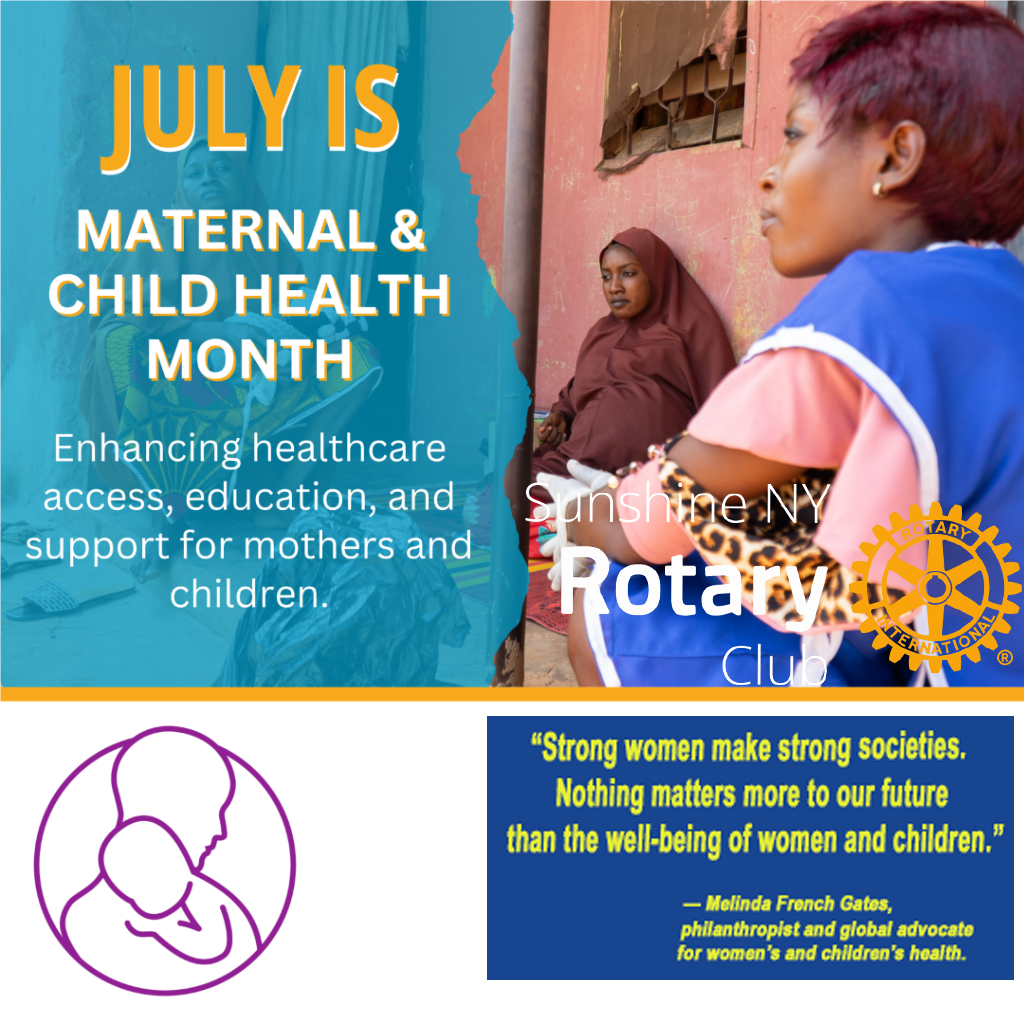
July is Maternal & Child Health Month
Healthy Beginnings, Stronger Communities
Each July, Rotary recognizes Maternal and Child Health Month, a time for Rotary and Rotaract clubs to help mothers, newborns, and children receive the care, information, nutrition, and support they need to live healthy and productive lives.
A healthy beginning can influence an entire lifetime. When mothers have access to quality prenatal care, skilled assistance during childbirth, postnatal support, adequate nutrition, clean water, immunizations, and reliable health services, both mothers and children have a better chance to survive and thrive.
Rotary’s Maternal and Child Health area of focus expands access to quality care, strengthens community health systems, trains health workers, prevents disease, and helps communities take greater control of their own health and well-being.
“Strong women make strong societies. Nothing matters more to our future than the well-being of women and children.”
— Melinda French Gates, philanthropist and global advocate for women’s and children’s health.
The Need Remains Urgent
The world has made meaningful progress in maternal and child survival, but millions of families still lack timely, affordable, and appropriate health care.
In 2023, approximately 260,000 women died during or following pregnancy and childbirth—more than 700 women each day and nearly one maternal death every two minutes. About 92 percent of these deaths occurred in low- and lower-middle-income countries, and most could have been prevented.
In 2024, an estimated 4.9 million children died before reaching their fifth birthday, equivalent to approximately one child every six seconds. About 2.3 million of those deaths occurred during the first 28 days of life, when newborns are especially vulnerable.
Behind every number is a mother, a child, a family, and a community. Many deaths result from conditions that can be prevented or treated through proven interventions such as skilled care during childbirth, prenatal and postnatal services, immunization, adequate nutrition, clean water and sanitation, and timely referral for emergency care.
Care Must Continue from Pregnancy Through Childhood
Maternal and child health is not defined by a single medical appointment or service. It is a continuum that begins before pregnancy and continues through childbirth, infancy, early childhood, and adolescence.
Strong programs may include:
- Health education and care before and during pregnancy
- Regular prenatal examinations and appropriate testing
- Skilled attendance during childbirth
- Emergency obstetric and newborn care
- Postnatal care for mothers and babies
- Breastfeeding and nutrition support
- Immunizations and preventive health services
- Screening and treatment for childhood illnesses
- Maternal mental-health services
- Safe water, sanitation, and hygiene
- Family-planning information and services
- Referral and transportation systems for medical emergencies
Projects are most effective when these services are connected rather than delivered in isolation.
Begin by Listening
The strongest Rotary projects begin with a community assessment, not with a predetermined donation.
Beliefs and practices surrounding pregnancy, childbirth, nutrition, breastfeeding, and childhood illness vary among communities. Transportation, language, cost, disability, immigration status, geography, discrimination, and distrust of institutions can also prevent families from seeking care.
Before designing a project, as a club we should speak with mothers, families, midwives, community health workers, physicians, nurses, public-health agencies, hospitals, and local organizations.
We should ask:
- What are the principal risks facing mothers and children?
- Which families are least able to obtain care?
- What prevents women from attending prenatal or postnatal appointments?
- Are trained health workers, medicines, equipment, clean water, and dependable electricity available?
- What happens when a mother or newborn needs emergency care?
- Which services already exist, and where are the gaps?
- What solution does the community consider realistic and sustainable?
Rotary’s current service guidance encourages clubs to listen first, use local expertise, align projects with existing health systems, plan for long-term change, and measure results.
What Can Our Club Do?
Maternal and child health projects can be local or international. A club does not need to construct a hospital or undertake a major grant to make a meaningful difference.
In our local communities
As a Club we can:
- Partner with hospitals, community health centers, health departments, WIC programs, family shelters, and home-visiting organizations.
- Organize diaper, infant-hygiene, maternity-clothing, or newborn-supply drives based on needs identified by a qualified community partner.
- Provide transportation assistance for prenatal, postnatal, pediatric, and immunization appointments.
- Support programs addressing postpartum depression, maternal mental health, domestic violence, or social isolation.
- Sponsor classes on safe infant sleep, breastfeeding, nutrition, infant care, or emergency preparedness led by qualified professionals.
- Help families obtain approved infant car seats and instruction in their correct installation.
- Support pregnant and parenting teenagers with education, mentoring, childcare, and connections to health services.
- Promote childhood immunization in collaboration with public-health authorities.
- Assist maternal shelters, pediatric hospitals, neonatal intensive-care units, and family-support organizations.
- Invite physicians, nurses, midwives, doulas, lactation specialists, and public-health professionals to speak at club meetings.
- Organize blood drives in cooperation with accredited blood-service organizations.
- Advocate for accessible, respectful, and culturally appropriate care for every mother and child.
Some Districts has highlighted hands-on local activities such as newborn welcome packages, diaper drives, hospital partnerships, and family-support projects as practical ways clubs can participate during July.
Through international service
Clubs can:
- Train and equip midwives, nurses, community health workers, and birth attendants.
- Support prenatal, delivery, postnatal, and newborn-care services in underserved communities.
- Provide appropriate medical equipment only after confirming that trained personnel, maintenance, replacement parts, electricity, and supplies will be available.
- Establish referral and emergency-transportation systems for mothers and newborns.
- Support mobile clinics in remote communities.
- Improve water, sanitation, hygiene, and reliable electricity in maternity and pediatric facilities.
- Expand access to immunization and childhood-disease prevention.
- Support maternal and child nutrition, breastfeeding education, and growth-monitoring programs.
- Help prevent mother-to-child transmission of HIV and other infections.
- Support cervical-cancer screening and HPV vaccination programs in cooperation with public-health authorities.
- Use district or global grants for sustainable, measurable projects developed with host clubs and community partners.
Rotary Zones 28 and 32 recommend activities including immunization programs, birthing kits, mobile health clinics, and professional training. Some Clubs and Districts have also emphasized prenatal care, nutrition education, transportation to health facilities, breastfeeding support, and stronger community health systems.
Strengthen Health Systems, Not Only Facilities
A new clinic, ambulance, incubator, or ultrasound machine may be valuable, but equipment alone does not guarantee better health.
A sustainable project also considers:
- Who will operate the equipment
- How personnel will be trained
- Whether electricity and clean water are dependable
- How equipment will be maintained and repaired
- Whether medicines and replacement supplies will remain available
- How patients will reach the facility
- What referral system exists for complicated cases
- How services will be funded after Rotary’s involvement ends
Rotary’s Global Health Pathway to Impact emphasizes strong data, sustainable programs, coordination with national and local health systems, and projects that connect multiple areas of focus.
Investing in local health workers is particularly important. Midwives, nurses, community health workers, physicians, and trained volunteers often provide the first—and sometimes only—connection between vulnerable families and lifesaving care.
Connect Rotary’s Areas of Focus
Maternal and child health is closely connected to Rotary’s other areas of focus.
Water, sanitation, and hygiene: Health facilities need safe water, toilets, handwashing stations, waste-disposal systems, and infection-control procedures. Families also need clean water and sanitation at home.
Disease prevention and treatment: Immunization, malaria prevention, HIV services, cervical-cancer prevention, and treatment of childhood illnesses directly improve survival.
Basic education and literacy: Mothers and caregivers need understandable health information. Girls who remain in school are generally better equipped to make informed decisions about their health and their children’s well-being.
Community economic development: Transportation costs, lost wages, unemployment, and poverty can prevent families from obtaining care. Economic security helps families afford nutrition, housing, medicine, and transportation.
Peacebuilding: Conflict and displacement can destroy health systems and place pregnant women and children at exceptional risk.
Integrated projects often produce stronger and more sustainable results than programs addressing only one issue.
Protect Dignity, Choice, and Equity
Every mother deserves respectful care, privacy, accurate information, and the opportunity to participate in decisions affecting her health. Every child deserves care without discrimination.
Projects should be designed to reach families who are most likely to be excluded, including those living in poverty, rural or isolated communities, refugee and immigrant families, people affected by conflict or disaster, people with disabilities, and those facing language or transportation barriers.
Community members should be partners in planning, implementing, and evaluating a project—not merely its recipients.
Build Effective Partnerships
As Rotary clubs, we can increase our impact by working with:
- Hospitals and community health centers
- Public-health departments
- Universities and medical schools
- Nursing, midwifery, and public-health programs
- WIC and early-childhood programs
- Maternal and family shelters
- Community health-worker organizations
- Refugee and immigrant organizations
- UNICEF, WHO, and other experienced health organizations
- Rotary and Rotaract clubs in project communities
- The Rotary Action Group for Reproductive, Maternal and Child Health
- The Rotary Foundation’s Cadre of Technical Advisers
Partners can provide medical expertise, community knowledge, data, referral networks, training, and continuity beyond the duration of Rotary funding.
Sunshine Rotary in Action
Sunshine Rotary’s service demonstrates that maternal and child health begins with dignity, safety, nutrition, clean water, and support for families facing difficult circumstances.
Restoring Health, Safety, and Privacy
In rural Bangladesh, the Club helped provide a hygienic toilet and enclosed shower for Monika and her children. Before the project, the family bathed in nearby ponds and lakes, where the water was polluted and where women and children had little privacy or protection. The new facilities give the family a safer and more dignified way to meet essential daily needs.
The Club also provided assistance to a distressed pregnant woman caring for three children. Although this was a small, family-level intervention, it reflected an important principle of maternal and child health: vulnerable mothers often need practical support—including food, clothing, hygiene materials, and connections to services—alongside medical care.
A Sunshine member similarly assisted a widowed immigrant mother in the Bronx who was caring for two young children after the family lost its principal wage earner. Through a District New Member Grant, she supplied approximately one month of rice, flour, lentils, cooking oil, snacks, and other groceries.
Clean Water Protects Mothers and Children
The Club’s continuing Gift of Water program has so far provided 12 tube wells to remote communities in Bangladesh. Safe water helps reduce waterborne illness, supports hygiene and nutrition, and relieves mothers and children of the burden of walking long distances to collect water.
These projects show how maternal and child health can be strengthened through direct family assistance and through infrastructure that improves health, privacy, safety, and dignity for entire communities.
Measure Lasting Change
Counting the number of kits distributed, workshops conducted, or pieces of equipment purchased describes activity—but not necessarily impact.
Depending on the project, clubs might measure:
- Increased attendance at prenatal and postnatal appointments
- Births assisted by trained health professionals
- Mothers and newborns receiving timely postnatal care
- Children completing recommended immunizations
- Improved maternal and child nutrition
- Reduced delays in emergency referrals
- Health workers completing accredited training
- Facilities consistently maintaining essential medicines and supplies
- Improved access to water, sanitation, electricity, and infection control
- Increased knowledge of pregnancy-warning signs and newborn-care practices
- Improved patient satisfaction and confidence in local services
- Reductions in preventable illness, complications, or deaths
Baseline information should be gathered before the project begins, followed by realistic targets and continued evaluation. Results should also be shared through Rotary’s Service Project Center so other clubs can learn from the experience.
Take Action This July
Healthy mothers and healthy children are the foundation of healthy families and resilient communities.
This July, let us listen to local families, engage medical and public-health professionals, strengthen trusted community institutions, and invest in solutions that continue long after a project is completed.
Whether your club supports one new mother, equips a community health worker, improves a maternity clinic, organizes an immunization initiative, provides transportation to medical care, or develops a larger grant-funded program, every thoughtful action can help protect a life and strengthen a family.
What will your club do to give mothers and children a healthier beginning?
Share your projects, results, and photographs via your website, social media and local media organizations and with District 7230. Together, we can recognize our members as People of Action, inspire other clubs, build stronger partnerships, and demonstrate the lasting impact of Rotary service.
Rotary Resources
- Rotary International — Improving Maternal and Child Health
- Rotary Service Project Center
- Rotary Community Assessment Tools
- Rotary Global Grants
- Rotary Impact Handbook
- Rotary Foundation Cadre of Technical Advisers
- Rotary Action Group for Reproductive, Maternal and Child Health
- World Health Organization — Maternal Health
- UNICEF — Child Survival and Under-Five Mortality